

By WellHealtrix Research Team
Published: May 20, 2026
We live in a world that never sleeps. With the invention of artificial electricity, smartphones, and global digital networks, the boundary between day and night has been completely erased. We treat sleep as an option—a luxury that we can cut down in order to squeeze more productivity, entertainment, or work into our lives. We pride ourselves on running on four or five hours of sleep, fueled by endless cups of caffeine.
But modern neuroscience and molecular biology are sending us a massive warning signal: Sleep is not a passive state of doing nothing. It is a highly active, non-negotiable biological mandate.
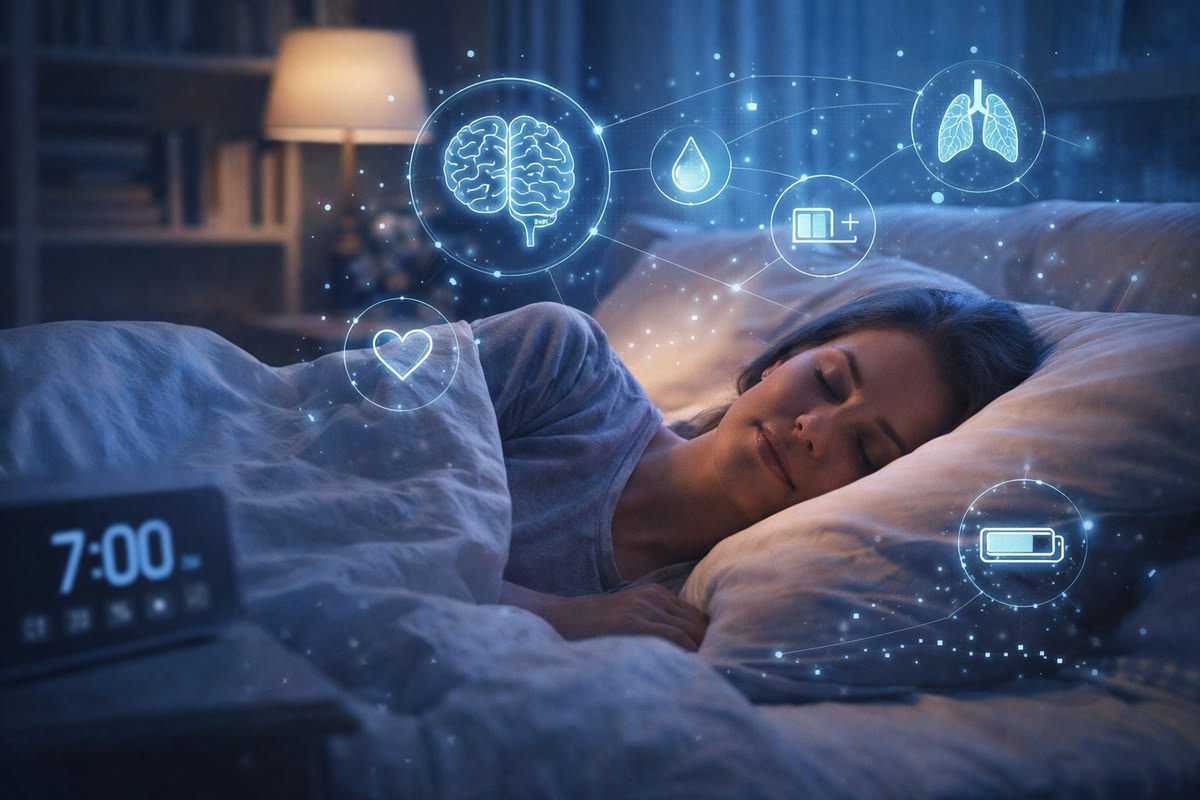
When you sleep, your body enters a state of intense cellular engineering. It is the only time when your brain washes away metabolic waste, your immune system fights off potential cancers, your DNA undergoes structural repair, and your mitochondria reset their energy factories. When you chronically deprive yourself of deep, high-quality sleep, you don’t just feel tired the next day; you are actively accelerating the aging process and opening the floodgates to chronic disease.
Welcome to WellHealtrix, where we decode the silent biological systems that dictate human health. In this masterclass guide, we will explore the intricate architecture of sleep, dive into the biochemistry of the circadian rhythm, look inside the brain’s nightly washing machine, and provide an actionable, science-backed framework to optimize your sleep for lifelong vitality.
Chapter 1: The Master Biological Clock (The SCN)
Every single cell in your body—whether it is a heart cell, a liver cell, or a skin cell—operates on a strict 24-hour schedule. This internal timing system is known as the Circadian Rhythm (from the Latin circa meaning “around” and diem meaning “day”).
But how do trillions of individual cells stay synchronized? They take their orders from a master coordinator inside your brain called the Suprachiasmatic Nucleus ($SCN$).
    [Sunlight/Blue Light] ───> Retina (Eyes) ───> SCN (Master Clock)
                                                        │
         ┌──────────────────────────────────────────────┴──────────────────────────────┐
         ▼                                                                             ▼
   DAYTIME PROTOCOL                                                              NIGHTTIME PROTOCOL
   • High Cortisol (Energy).                                                     • High Melatonin (Sleep).
   • High Core Body Temp.                                                        • Drop in Core Temp.
   • Suppressed Melatonin.                                                       • Active Cellular Repair.
The $SCN$ is a tiny cluster of 20,000 neurons located inside the hypothalamus, sitting directly above your optic nerves. Its primary job is to analyze the light wavelengths entering your eyes.
- The Daytime Protocol: When the $SCN$ detects natural blue light from the morning sun, it signals your adrenal glands to release cortisol (your primary hormone for alertness, focus, and energy) and raises your core body temperature.
- The Nighttime Protocol: When the sun sets and light fades, the $SCN$ signals the pineal gland to begin manufacturing and secreting melatonin (the hormone of darkness), which prepares every organ system for rest and recovery.
If you blast your eyes with artificial blue light from TV screens, tablets, and smartphones at 11:00 PM, you trick your $SCN$ into believing it is 12:00 noon. Cortisol stays high, melatonin is suppressed, and your body’s internal repair schedule is completely disrupted.
Chapter 2: The Four Stages of Sleep Architecture
Sleep is not a single, continuous block of unconsciousness. Instead, your brain travels through highly structured 90-minute waves known as Sleep Cycles. A healthy night of rest consists of 4 to 6 of these cycles, which are divided into two distinct phases: Non-REM (Rapid Eye Movement) and REM sleep.
  ┌────────────────────────────────────────────────────────────────────────┐
  │                        THE 90-MINUTE SLEEP CYCLE                       │
  └───────────────────────────────────┬────────────────────────────────────┘
                                      │
         ┌────────────────────────────┼────────────────────────────┐
         ▼                            ▼                            ▼
   STAGE N1 & N2                STAGE N3 (SWS)                 REM SLEEP
   (Light Sleep)                 (Deep Sleep)               (Dream State)
• Muscle relaxation.          • Physical healing.          • Cognitive storage.
• Heart rate slows down.      • Growth hormone surge.      • Emotional processing.
• Transition phase.           • Mitochondrial repair.      • Vivid dreams occur.
2.1 Stage N1 & N2 (Light Non-REM Sleep)
This is the transition phase. Your muscles begin to relax, your heart rate slows down, and your brain waves change from active beta waves to slower theta waves. You spend roughly $50\%$ of your night in Stage N2.
2.2 Stage N3: Slow-Wave Sleep (Deep Sleep)
This is the holy grail of physical recovery. During Deep Sleep, your brain waves slow down to massive, synchronized delta waves.
- Your blood pressure drops, and blood flow is redirected away from your brain and straight into your muscles and tissues.
- Your pituitary gland releases a massive pulse of Human Growth Hormone ($HGH$), which stimulates cellular reproduction, tissue growth, and muscle repair.
- Your mitochondria reduce their workload, neutralizing the free radicals built up during the day and rebuilding $ATP$ energy reserves.
2.3 REM Sleep (The Dream State)
During REM sleep, your brain becomes highly active—almost as active as it is when you are wide awake. Your eyes move rapidly behind closed lids, but your motor neurons are completely paralyzed to prevent you from acting out your dreams.
- Cognitive Processing: REM sleep is where memory consolidation happens. Your brain takes the short-term information gathered during the day, processes it, and stores it inside the long-term architecture of your cortex.
- It is also the phase where emotional processing occurs, acting as a natural overnight therapy session to strip away stress from traumatic or emotional memories.
Chapter 3: The Glymphatic System – The Brain’s Nightly Garbage Truck
One of the most revolutionary scientific discoveries of the last two decades is the discovery of the Glymphatic System.
Your body clears out cellular waste through the lymphatic system, but the human brain is completely sealed off from the rest of the body by the blood-brain barrier. For a long time, scientists did not know how the brain disposed of its own metabolic trash.
In 2012, researchers discovered that during Deep Non-REM Sleep, a specialized waste-clearance system activates inside the cranium.
[Deep Sleep Activates] ──> [Brain Cells Shrink 60%] ──> [CSF Floods the Tissue] ──> [Flushes Away Beta-Amyloid]
When you enter deep delta-wave sleep, your glial cells (support cells in the brain) physically shrink by up to $60\%$. This shrinking creates wide pathways between your neurons.
Instantly, Cerebrospinal Fluid ($CSF$) rushes into the brain tissue like a high-pressure washing machine. It glides through the spaces, collecting metabolic debris that accumulated during waking hours. The most important piece of waste it flushes away is a toxic protein called Beta-Amyloid.
If you cut your sleep short, this waste clearance fails. The beta-amyloid proteins build up day after day, forming sticky plaques that eventually destroy brain connections—the primary driving mechanism behind Alzheimer’s disease and dementia.
Chapter 4: Sleep Deprivation and the Metabolic Breakdown
When your sleep architecture is fractured, the consequences extend far beyond your brain. It completely deranges your metabolic health.
4.1 The Hunger Hormones: Leptin vs. Ghrelin
Just one single night of partial sleep deprivation (sleeping 4 to 5 hours) throws your appetite-regulating hormones into chaos:
- Ghrelin Levels Spike: Ghrelin is the hormone that signals hunger to your brain. When sleep is low, ghrelin increases significantly, making you feel ravenous.
- Leptin Levels Drop: Leptin is the hormone that signals fullness and satiety. Sleep deprivation suppresses leptin, meaning your brain never receives the signal that you are full.
- This combination triggers intense, uncontrollable cravings for high-calorie, highly refined carbohydrates and sugars the next day.
4.2 Acute Insulin Resistance
In clinical studies, when healthy young individuals were restricted to 4 hours of sleep for just four consecutive nights, their cellular sensitivity to glucose plummeted by $40\%$. Their fat and muscle cells resisted insulin as severely as an individual with Type 2 Diabetes. Sleep deprivation forces your body into a chronic state of survival stress, flooding your bloodstream with glucose that cannot be safely cleared.
Chapter 5: The WellHealtrix Sleep Optimization Protocol
To restore your sleep architecture, maximize deep delta sleep, and supercharge your glymphatic waste clearance, you must align your lifestyle with circadian biology. Follow these four foundational pillars:
 ┌───────────────────────────────────────────────────────────┐
 │                SLEEP OPTIMIZATION PROTOCOL                │
 └─────────────────────────────┬─────────────────────────────┘
                               │
       ┌───────────────┬───────┴───────┬───────────────┐
       ▼               ▼               ▼               ▼
 MORNING LIGHT    CAFFEINE CURFEW  LIGHT DIGITAL    THERMAL DIVE
  ANCHORING          (02:00 PM)       BLACKOUT     (Cool Room Temp)
(Outdoor Sun)                      (Blue Blockers)  (65-68°F / 18°C)
1. Anchor Your Master Clock with Morning Sunlight
The circadian rhythm is set by the first ray of light that hits your eyes in the morning.
- The Action: Within 30 minutes of waking up, step outside into natural sunlight for 10 to 15 minutes. Do not look through a glass window, as glass filters out the essential lux wavelengths needed to stimulate the $SCN$.
- The Benefit: This morning light exposure triggers an immediate surge of cortisol, giving you instant energy, while simultaneously starting a countdown timer for melatonin production 14 to 16 hours later.
2. Implement a Strict Caffeine Curfew
Caffeine is a powerful central nervous system stimulant that works by blocking Adenosine receptors in your brain. Adenosine is a chemical that naturally builds up in your brain every hour you are awake, creating “sleep pressure.”
- The Half-Life Reality: Caffeine has a half-life of roughly 6 hours and a quarter-life of 12 hours. If you drink a cup of coffee at 4:00 PM, a quarter of that caffeine is still actively circulating inside your brain at 4:00 AM, completely stripping you of deep slow-wave sleep.
- The Rule: Establish a hard caffeine curfew at 02:00 PM.
3. Establish a Digital Light Blackout
To protect your pineal gland’s ability to manufacture melatonin, you must eliminate artificial evening blue light.
- Two Hours Before Bed: Turn off bright overhead ceiling lights. Switch to low-level lamps with warm orange or red bulbs, which do not disrupt circadian biology.
- The Screen Hack: If you must use a laptop or smartphone at night, install blue-light blocking software, wear certified red-lens blue-blocking glasses, and keep the screen brightness as low as possible.
4. Trigger the Thermal Dive
Your body cannot enter deep sleep unless its core temperature drops by roughly $2^{\circ}\text{F}$ ($1^{\circ}\text{C}$).
- Keep It Cool: Set your bedroom thermostat to a cool temperature between $65\text{ to }68^{\circ}\text{F}$ ($18\text{ to }20^{\circ}\text{C}$).
- The Hot Shower Trick: Taking a warm bath or hot shower 90 minutes before bed sounds counterintuitive, but it causes blood vessels in your hands and feet to dilate (vasodilation). When you step out of the bath, heat quickly radiates out of your body, plunging your core temperature and triggering a powerful sleep signal to your brain.
Chapter 6: Nutritional Co-Factors for Restful Sleep
To assist your brain in manufacturing the neurochemicals required to calm your nervous system, ensure your diet contains these sleep-inducing micronutrients:
- Magnesium Glycinate / Threonate: Magnesium acts as a natural relaxant by binding to GABA receptors in the brain—the primary inhibitory neurotransmitter that calms down racing thoughts. Magnesium Threonate has the unique ability to cross the blood-brain barrier efficiently.
- L-Theanine: An amino acid found naturally in green tea that increases alpha-wave activity in the brain, promoting deep relaxation without causing drowsiness.
- Tart Cherry Juice: A natural dietary source of melatonin and proanthocyanidins, which help increase the availability of tryptophan, the essential amino acid precursor to serotonin and melatonin.
Chapter 7: The Perfect Evening Circadian Routine
To transform these biological principles into a regular lifestyle habit, follow this evening wind-down matrix:
| Time of Evening | Circadian Action | Biological System Response |
| 02:00 PM | Hard curfew on all forms of caffeine (coffee, energy drinks, black teas). | Allows the liver enough time to clear circulating stimulants, protecting adenosine sleep pressure. |
| 07:00 PM | Consume your final meal of the day. Avoid heavy proteins or spicy ingredients late at night. | Prevents digestive blood flow from raising core body temperature and disrupting nighttime growth hormone. |
| 09:00 PM | Dim all household lights. Turn off the television and place your smartphone on airplane mode. | Signals the Suprachiasmatic Nucleus ($SCN$) that night has arrived, triggering a natural surge of melatonin. |
| 09:30 PM | Take a warm bath or hot shower, then step into a pre-cooled bedroom ($67^{\circ}\text{F}$). | Initiates rapid core body cooling, sending a strong physical signal to enter deep slow-wave sleep. |
| 10:30 PM | Head to bed in a completely dark room (use blackout curtains or an eye mask). | Provides an optimal sensory environment for uninterrupted REM and deep sleep architecture. |
Conclusion: Reclaim Your Night to Protect Your Day
In our modern society, sleep is often viewed as a weakness—an inconvenient obstacle to getting things done. But science paints a completely different picture. Sleep is the foundation of your health pyramid.
Without it, your healthy diet cannot be processed correctly, your exercise cannot heal your muscles, your brain cannot clear its waste, and your heart highways will suffer from chronic inflammation.
Optimizing your sleep is an act of self-respect. It is an understanding that to perform at your peak, think with razor-sharp clarity, maintain a healthy weight, and protect yourself from devastating neurological diseases, you must respect the ancient circadian rhythms embedded inside your DNA.
Turn off the lights, quiet your mind, cool your environment, and let your body perform its natural nightly miracle of cellular rebirth. Let WellHealtrix continue to support you on your path to vibrant, lifelong health.
Your Sleep Action Checklist:
- View natural sunlight for 10-15 minutes every morning to lock in your internal 24-hour biological clock.
- Stop all caffeine intake by 2:00 PM to ensure your brain can accumulate natural sleep pressure.
- Lower the temperature of your bedroom to a cool 65-68°F ($18-20^{\circ}\text{C}$) to facilitate deep sleep entry.
- Eliminate bright artificial blue light screens for at least 60 to 90 minutes before your head hits the pillow.